Intro
Feeling despair at trying to get your aging building assets to be more efficient is like listening to nails on a chalkboard. Sometimes the plant room is lucky that everything is working. So if you’re an energy or facilities manager tasked with saving money on your commercial heating plant. Try having a read of this post to explore how to assess potential energy savings.
Just listen to what Anticipate London says about Energy effeciency for facilities managers here
We cover hot water, fan coil, or AHU circuits. Wouldn’t it be great if you could know how to nail this, intuitively in just five minutes?
If this all sounds like jargon and you’re transitioning from a soft FM role to a hard FM one, you’re in the right place. I love discussing those flashing lights and large pieces of equipment in your plant rooms! With over 15 years as a heating engineer, I’ve identified telltale signs that can help you maximize system efficiency and save money. You can then communicate to these suggestions to your maintenance team.
Understanding Your Commercial Heating System’s Efficiency
Understanding your heating system’s efficiency begins with recognizing key components, such as condensing boilers, which can significantly improve energy performance. –However, this efficiency depends on maintaining the return temperature of the water going back to the boiler as low as possible.–
In typical radiator or underfloor heating systems, this is achieved by adjusting the heating flow temperature according to the outside air temperature. Historically, weather compensators controlled actuated valves to lower the heating system’s temperature, but modern boilers or building management systems now handle this.
Maximizing Efficiency with Variable Temperature (VT) Circuits
By adjusting the temperature on the heating circuit, you can realize greater efficiencies with what are called variable temperature (VT) circuits. Heat modulation occurs through the boiler’s output or a mixer valve. Ensure that your heating or controls contractor has set this up correctly to achieve optimal operation and energy savings.
If the building experiences large temperature swings and has radiators, this is an excellent area to address. Constant temperature circuits are more challenging. They typically maintain a 70°C-80°C set point for AHUs, fan coils, and indirect hot water systems. When it comes to constant temperature (CT) circuits. Control valves that rarely open, as this may indicate an overly high set point. Mastering these aspects will save money and impress your boss with your energy-saving skills.
Key Note on 3-Port Modulating Valves
Three-port modulating valves come in various shapes and sizes, but people often mistakenly associate them solely with VT circuits. These valves can actually be used in both VT and CT circuits. They may even be the same make and model. Look at the pump position to determine if the valve will be diverting or mixing.
Below is an extract from a data sheet for a Honeywell control valve. I know it looks like a load of squiggly lines, but it does illustrate my point.
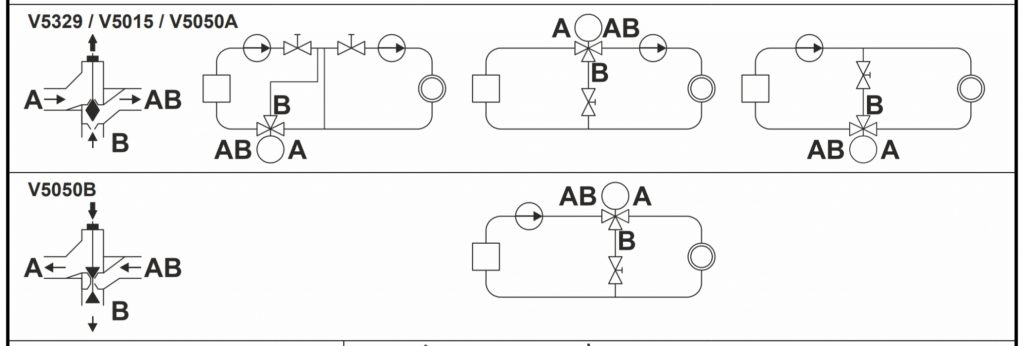
Identifying Summer Heating Issues in Your Plant Room
If your plant room feels stifling hot in the middle of summer, it’s essential to ask why. Check if you’re running a CT circuit; if not, reach out to your controls or heating contractor. If they’ve held the maintenance contract for years, a non-functional control system may be to blame.
Implementing effective control systems is crucial to optimizing your heating system. These systems essentially tell all the heating equipment what to do. So if your controls are old, broken, or not in use, then they need attention. Start by addressing these issues to ensure everything is working.
Steps to Improve Control System Efficiency
After ensuring the control system works, you can focus on hot water pasteurization strategies to balance safety and efficiency. Lowering the temperature in condensing boiler circuits also boosts efficiency by preventing short cycling and reducing the amount of cooler combustion products lost up the chimney.
Analyzing control valve data can reveal demand patterns, enabling precise adjustments and improved system performance.
Engaging with Engineers for Better Results
Collaborate with both controls and heating engineers to optimize your heating system. Hot water fan coils and AHUs typically operate on CT circuits, which impact overall system efficiency. Maintaining a cooler CT circuit also keeps the boiler circuit cooler, reducing short cycling, lowering return temperatures, and minimizing hot flue gases.
Real-World Example: The Strebel SCB-80 Boilers
In one example. I worked on a pair of Strebel SCB-80 boilers that were significantly undersized for the load they handled . With a peak load of 300 kW, the boilers, with a max capacity of only 160 kW, were often pushed to 90°C and ran 24/7 for months.
Though they were only a couple of years old, one boiler already had a split heat exchanger upon my inspection, likely due to the constant high temperature. The client replaced it, but the increased load on the remaining boiler caused that one to split as well. –Seven years in, they had to replace both boilers and the flue system at a cost of nearly £15,000.–
Enhancing Plant Room Efficiency with Our Checklist
To further improve plant room efficiency, download our comprehensive energy efficiency checklist. –This checklist covers essential areas, from temperature settings to control system checks, to help you spot inefficiencies and make actionable improvements.– You’ll save time, money, and resources, while staying informed on advanced energy management techniques.
Conclusion: Achieving Energy Savings and System Efficiency
By following the outlined strategies, you’ll quickly learn how to assess energy savings, maximize system efficiency, and communicate improvements to your subcontractor. These steps will enhance system performance and showcase your energy management expertise. Download our plant room efficiency checklist and join our newsletter for more insights on optimizing heating systems with weather compensation.