The cheapest way to monitor a hydronic heating or cooling system
Why This Topic Matters for Heating Professionals
With commercial heating systems under pressure to reduce energy waste and demonstrate ROI, finding affordable ways to measure system performance is essential. High-cost metering solutions often stall energy-saving projects before they begin. This topic matters because it shows how differential pressure (DP) transducers—an often overlooked bit of kit—can turn that challenge into a competitive advantage.
It ties directly into the broader industry push for decarbonisation and smarter energy management. In today’s environment, where funding and client buy-in rely on proving savings, being able to collect reliable data affordably can make or break a project.
A common misconception is that monitoring requires full heat meter installations and expensive BMS integration. In reality, engineers can collect actionable data using kit they already work with—like commissioning sets and budget-friendly sensors.
Stop Letting Monitoring Costs Kill Your Energy-Saving Projects
Picture this: you’ve designed a solid energy-saving upgrade for a building—but the project stalls because you can’t prove the ROI without spending £5K on heat metering. Sound familiar?
This post explains how heating engineers can avoid that roadblock. By using differential pressure transducers tapped into existing commissioning sets, you can monitor kilowatt (kW) output for a fraction of the cost. That means faster commissioning, more work won, and real proof of savings—without the overhead.
Here’s why this matters:
- Energy-saving work is often delayed by the high cost of monitoring.
- Budget-friendly monitoring opens the door to more retrofit wins.
- You can help clients make smarter decisions—and back it up with real data.
1. Energy-Saving Work is Often Delayed by Expensive Monitoring
Let’s face it—if you can’t measure it, you can’t prove it. But traditional monitoring tools are expensive. Clamp-on meters can be inaccurate on old pipework, and they aren’t designed for long-term tracking. Heat meters are accurate, but by the time you buy, install, and integrate one, you’re easily £3K–£5K each.
That’s where DP transducers shine. You can install them quickly, gather meaningful data, and keep energy-saving work moving without budget blowouts.
A. Clients Don’t Invest Without Proven ROI
Clients are rightly cautious. They want performance proof before signing off on upgrades. Being able to show real-world energy data—even with a simple DP setup—makes your proposal stronger.
B. Retrofit Momentum Stalls Without Data
When savings can’t be verified, decision-makers hesitate. A quick sensor-based setup keeps the project alive and the energy team engaged.
C. Long-Term Monitoring, Low Cost
If you connect your transducers to a BMS, they can collect valuable data over time. This gives the FM or energy manager a full picture of system performance and trends.
2. A Pressure Transducer = A Cheap Way to Track Energy Use
Many engineers don’t realise that with a DP transducer and two temperature sensors, you can measure the thermal output of a hydronic system with decent accuracy. Flow is calculated from pressure drop using the valve’s data sheet; add temperature differential and the heat output in kW is easy to calculate.
A. Cheap and Cheerful Kit
A Sonata DP transducer costs just £300–£400. Compare that to £1,500+ for a 2″ heat meter. For many clients, that’s the difference between doing the project or not.
| REGULAR HEAT METER INSTALLATION | DP TRANSDUCER MONITORING |
| 2″ Kamstrup 603 Heat meter £906 | Sontay Differential Pressure Sensors PL-692-1 £327 |
| Cutting and threading 2″ flanges £2000 | Fitting 6mm copper pipe to commisioing set £600 |
| Controls engineer £700 | Controls engineer £750 |
B. Log and Analyse with Basic Tools
You can log results using low-cost hardware like a Schneider Zelio controller or wireless data logger. The data can be analysed later or streamed into a dashboard. No BMS? No problem.
C. Minimal Plumbing, Maximum Value
You don’t need a full drain-down. Just connect to ¼” BSP test points on a commissioning set. You could install multiple sensors in a plant room in a single day—fittings cost less than £50.
3. How to Set One Up: From Binder Points to Live Energy Readings
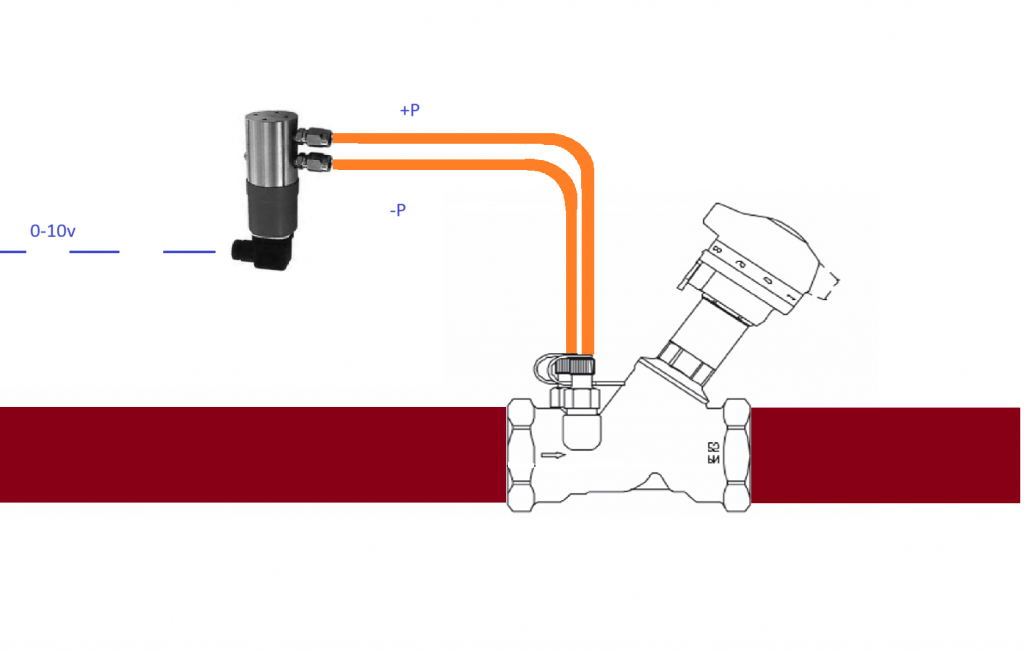
Here’s how you do it: Identify the commissioning set and find its data sheet. Isolate the legs and swap the binder points for needle valves. Then add 6–8mm pipe with a bypass and install the DP transducer. Add a pair of temperature sensors and wire them back to a logger or simple controller.
Then it’s just a case of running the numbers:
kW = ΔT × Flow (kg/s) × Specific Heat of Water
With this live data, you can monitor thermal energy flow and make informed decisions.
A. Try Our Controls Course for Hands-On Skills
We cover the full process in our mini-course—from plumbing to programming. It’s a great intro to hands-on controls and energy monitoring.
B. Set Up a Demo Rig
Use an old commissioning set and a small pump to build a demo rig. It’s a cheap training tool—and a powerful way to showcase what you can do to clients. Below is a diagragm of the set up
C. Score Seasonal Wins
Install temporary sensors during seasonal trials. Collect data. Show clients the difference. Then pitch further upgrades based on actual performance. You’ll turn temporary installs into permanent contracts.
Conclusion: The Smart Way to Monitor, Save, and Win More Work
What we’ve seen in all three points is clear: you don’t need to spend thousands to get solid energy data. By using DP sensors and a bit of smart plumbing, you can unlock opportunities, speed up commissioning, and help your clients make smarter decisions.
Recap of Benefits:
- Low-cost setup removes the budget barrier to monitoring.
- Quick installs reduce downtime and deliver faster insights.
- Real-time data helps prove ROI and builds client trust.
Ultimately, you could be saving your client around £5K per meter by using DP sensors instead of heat meters. That means you capture more revenue—and help your clients capture more savings.
✅ Explore Further and Take Action
→ Join our email list for more tips like this
→ If you’re an FM, check out our plant room asset survey with free 3d scan
→ Pass these tips to your subcontractors and start delivering value immediately
📚 Bonus Resources:
Explore external resources to deepen your knowledge:
- CIBSE TM39 – Building Energy Metering
- Carbon Trust guides on energy management
- Manufacturer case studies on using DP sensors (check brands like IMI, Siemens, Belimo)
Look into wireless data loggers and smart BMS integrations for deeper insights and more powerful long-term data strategies